

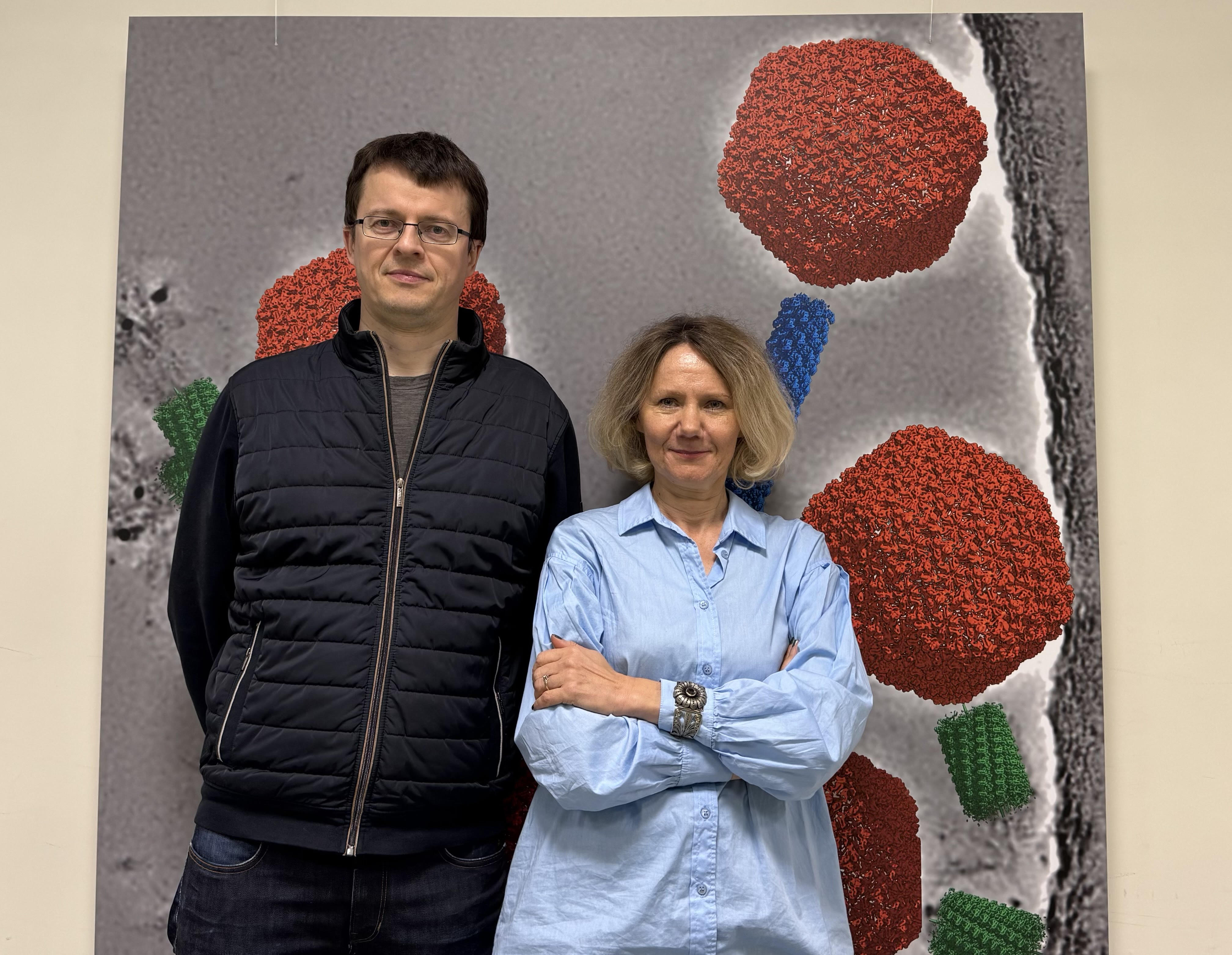
When Prof. Vytautė Starkuvienė-Erfle first went to the European Molecular Biology Laboratory (EMBL) in Heidelberg for a research fellowship in 1997, Lithuania was neither a member of the European Union nor a member of this prestigious scientific organization.
“At that time, EMBL felt very distant to us – most people didn’t even know about it,” recalls the scientist, who today works at Vilnius University and Heidelberg University and leads Lithuania’s EMBL membership project.
Her path to one of Europe’s most advanced research institutions began by chance.
“I attended a conference on automated DNA sequencing methods. Professional connections emerged, and I received an invitation for a fellowship. At the time, I didn’t plan to stay long - everything just developed naturally,” she says.
Over the past decades, the situation has changed dramatically. In 2019, Lithuania became a full member of EMBL, and a partnership institute of EMBL specializing in gene editing was established at the Life Sciences Center of Vilnius University (VU LSC). According to Prof. Starkuvienė-Erfle, this was far more than a symbolic step.
“Membership in EMBL opened access to cutting-edge technologies, training and professional development opportunities, and international research networks. We were able to organize courses for researchers and students in Lithuania, rather than relying solely on international study opportunities. This is important because it allows us to involve more people from different Lithuanian universities and institutes, especially early-career researchers,” she explains.
Among the most significant examples, she highlights gene editing. According to her, Lithuania’s expertise in gene editing has been recognized as exceptionally high – this is why EMBL granted Lithuania partnership status in this field. This is a significant recognition, as there are only a few such partnership institutes across Europe.
EMBL is the only intergovernmental organization in Europe that brings together scientists working in molecular and cellular biology. Its mission is to promote fundamental research in molecular biology, provide access to open-access facilities, comprehensively strengthen researchers’ competencies, collaborate with the biotechnology industry, and coordinate European life sciences policy.
The most advanced open science infrastructure
While EMBL unites molecular biology researchers, another international infrastructure – Instruct-ERIC – opens doors for the structural biology community. Its goal is to provide free access to expensive, highly specialized equipment that most countries do not possess.
“Structural biology studies what biomolecules - proteins and nucleic acids - look like and how they function. This requires extremely costly infrastructure, such as synchrotrons, electron microscopy, and nuclear magnetic resonance systems,” explains Dr. Giedrius Sasnauskas, a scientist at the VU Life Sciences Center who leads Lithuania’s Instruct-ERIC membership.
He emphasizes that this infrastructure is not just about “instruments.” It is an entire system that includes training and long-term fellowships. Lithuanian scientists can submit applications, receive free access to equipment, and even obtain compensation for the transportation of samples. This access levels the playing field between countries with strong scientific ecosystems and those that are still building them.
According to Dr. Sasnauskas, during the first year of activity, Lithuanian researchers have already collected data at the DESY center in Hamburg, optimized protein production in the United Kingdom, and published the first joint scientific paper based on Instruct services this year.
“What’s most interesting is that it was prepared not by structural biologists, but by researchers from another field. This shows that Instruct can be useful to an extensive range of scientists – anyone working with macromolecules,” he adds.
Encouraging talent to return
Both infrastructures provide Lithuania not only with scientific but also strategic advantages.
“First and foremost – visibility. Each member state has representatives who participate in decisions on EMBL’s strategic, scientific, and financial matters. Lithuania is represented by Prof. Virginijus Šikšnys and Dr. Toma Lankauskienė, who recently replaced long-time representative Dr. Milda Jodinskienė. Prof. Šikšnys has also been elected Vice President of the EMBL Council. This means Lithuania sits at the table where European science policy is shaped,” explains Prof. Starkuvienė-Erfle.
According to her, this is not merely symbolic. Lithuanian representatives can influence decisions, participate in shaping new programs, and ensure that their country's national interests are represented and heard.
Dr. Sasnauskas adds that Instruct membership allows smaller countries to compete with scientific powerhouses – Lithuanian researchers now have access to the same equipment as colleagues in Germany or Sweden.
Moreover, both infrastructures help create conditions for talent to return and work in Lithuania.
“We have scientists who returned with prestigious EMBO Installation Grant funding – this allows them to establish their own laboratories and even new research directions in Lithuania,” says Prof. Starkuvienė-Erfle.
She emphasizes that this is not only about funding – the most critical aspect is the opportunity to be part of an international network, to share experience and ideas. Sometimes a single conversation with a colleague from another country helps avoid mistakes that might otherwise occur in Lithuania. A significant long-term outcome of Lithuania’s EMBL membership is closer collaboration with both long-standing members and newly joined countries.
“As an example, we can mention recently established contacts with Estonian EMBL membership project leaders, who asked us to share our accumulated experience and with whom we plan to implement joint projects,” says Prof. Starkuvienė-Erfle.
“I wouldn’t call this a fight against ‘brain drain.’ Going abroad is beneficial. What matters is having somewhere to return to – and membership in infrastructures such as Instruct or EMBL provides a real foundation for that,” adds Dr. Sasnauskas.
Looking ahead
Both organizations are working in Lithuania to engage more researchers. According to the interviewees, the biggest challenge so far is reaching scientists across the entire country – those working at universities in Kaunas and Klaipėda, the Nature Research Centre, the National Cancer Institute, the Center for Physical Sciences and Technology (FTMC), and other research institutions.
“Sometimes you go to a meeting and hear, ‘We didn’t even know we could participate.’ But that’s a normal situation – the flow of information is enormous. When you clearly explain what is available and what opportunities can be used, interest grows, questions start coming in, and then the search for possibilities begins,” says Prof. Starkuvienė-Erfle.
Both scientists agree that Lithuania must continue its membership.
“EMBL is the only intergovernmental organization in Europe uniting molecular biology researchers. Dropping out would mean losing the entire context – from joint projects, researcher mobility, and funding schemes to the most valuable thing of all: academic reputation,” stresses Prof. Starkuvienė-Erfle.
Dr. Sasnauskas adds that Instruct’s evolution in Lithuania is only just beginning. Since October of this year, Lithuania has had an official research center, known as a “Research Site,” which enables the organization of training courses in the country.
“The long-term goal is to become a regional hub that attracts scientists from other European countries. That would be a natural continuation of our path,” concludes Dr. Sasnauskas.