

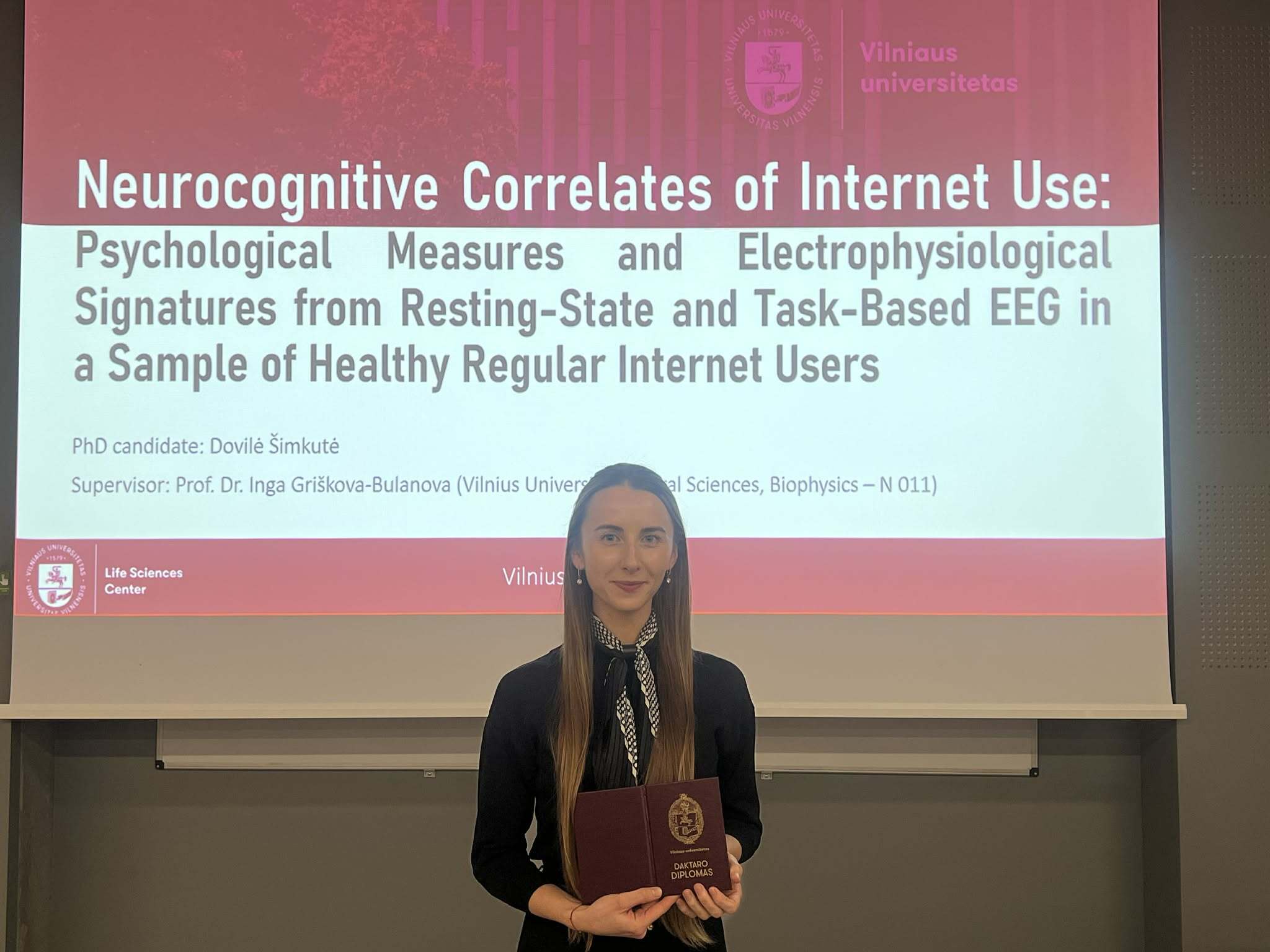
Dovilė Šimkutė defended her thesis entitled "Neurocognitive Correlates of Internet Use: Psychological Measures and Electrophysiological Signatures from Resting-State and Task-Based EEG in a Sample of Healthy Regular Internet Users" for the degree of Doctor of Science in Biophysics.
Scientific supervisor: Prof. Dr. Inga Griškova-Bulanova (Vilnius University, Natural Sciences, Biophysics).
Composition of the Dissertation Defense Board: Chairperson - Prof. Dr. Aidas Alaburda (Vilnius University, Natural Sciences, Biophysics); Assoc. Prof. Dr. Rokas Buišas (Vilnius University, Natural Sciences, Biophysics); Assoc. Prof. Dr. Aušra Daugirdienė (Vilnius University, Social sciences, Psychology); Prof. Dr. Roma Jusienė (Vilnius University, Social sciences, Psychology); Dr. Marko Živanović (University of Belgrade, Serbia, Natural Sciences, Biophysics).
Problematic Internet Use (PIU) is developing against the backdrop of widespread internet accessibility; however, a consensus on its definition and assessment is still lacking. In this study, internet use habits were examined in a non-clinical sample to identify signs associated with the early formation of problematic engagement. Participants completed a set of self-report questionnaires assessing psychological symptoms, interoception, and personality traits, and they also performed an auditory-level probability Go/NoGo task. During the task, as well as during resting state, electroencephalography (EEG) was recorded to evaluate event-related potentials (ERPs), alpha asymmetry, and microstates.
A network analysis of interoception–personality traits–internet use revealed associations between lower interoceptive awareness and higher engagement in online activities; links between interoception and internet use were also mediated by neuroticism. Behavioral Go/NoGo performance indicators did not reflect the level of engagement in online activities; however, associations were identified between ERP measures and the use of specific platforms: decreased N1 amplitude (gaming platforms), shorter Go-N1 latency (overall platform use), and longer NoGo-P3 latency (information-search platforms).
Resting-state EEG data showed greater left-hemisphere activity in the occipital region and a higher occurrence rate and contribution of microstate E among individuals with higher levels of internet use. In summary, the results reflect a shift toward a predominance of externally driven, reactive “bottom-up” attentional processing and lower awareness of bodily sensations as the level of internet use increases.