

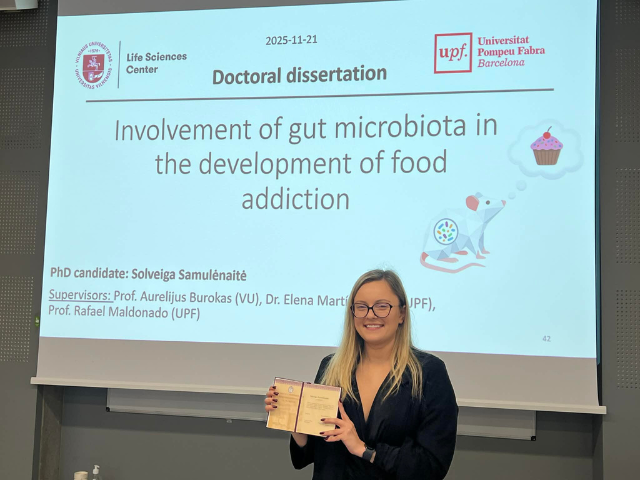
Solveiga Samulėnaitė defended her thesis entitled "Involvement of the Gut Microbiota in the Development of Food Addiction" for the degree of Doctor of Science in Biochemistry.
Scientific supervisor:
Prof. Dr. Aurelijus Burokas (Vilnius University, Natural Sciences, Biochemistry);
Prof. Dr. Rafael Maldonado (Pompeu Fabra University, Neuropharmacology, Health and Welfare, Medicine);
Dr. Elena Martín-García (Pompeu Fabra University, Neuropharmacology, Natural sciences, Neuroscience).
Composition of the Dissertation Defense Board:
Chairperson - Prof. Dr. Osvaldas Rukšėnas (Vilnius University, Natural Sciences, Biophysics); Dr. Emmanuel Darcq (University of Strasbourg, Natural Sciences, Biochemistry); Prof. Dr. Marta Rodríguez-Arias (University of Valencia, Natural Sciences, Biology); Prof. Dr. Fernando Rodríguez de Fonseca (IBIMA-Hospital Regional Universitario de Málaga, Natural Sciences, Biochemistry); Dr. Cristina Torres Fuentes (Rovira i Virgili University, Natural sciences, Biochemistry).
In Western societies, the increasing consumption of high-calorie, processed foods elevates the risk of food addiction. Individuals with food addiction typically exhibit heightened compulsivity, persistence, and motivation to consume such foods. Although scientific studies confirm an overlap in the neurobiological mechanisms underlying food and drug addictions, the precise mechanisms remain incompletely understood. Emerging research shows that the gut microbiota may significantly influence brain function through the gut–brain axis.
Therefore, this dissertation investigates the neurobiological mechanisms of food addiction and the role of the gut microbiota in its development. Using an operant mouse model based on the development of addiction to chocolate-flavored pellets, we first applied a chemogenetic approach to examine the neurobiological mechanisms of cognitive flexibility and its importance in the progression of food addiction. Second, we identified specific gut microbiota biomarkers in humans and mice with food addiction. Based on these findings, we used potential prebiotics and probiotics, which helped prevent the development of food addiction in mice. Finally, we confirmed that gut microbiota transplantation may be a suitable strategy to modulate cognitive functions in mice.
Overall, our results demonstrate that modulating gut microbiota composition may help protect against cognitive decline and the development of food addiction.