

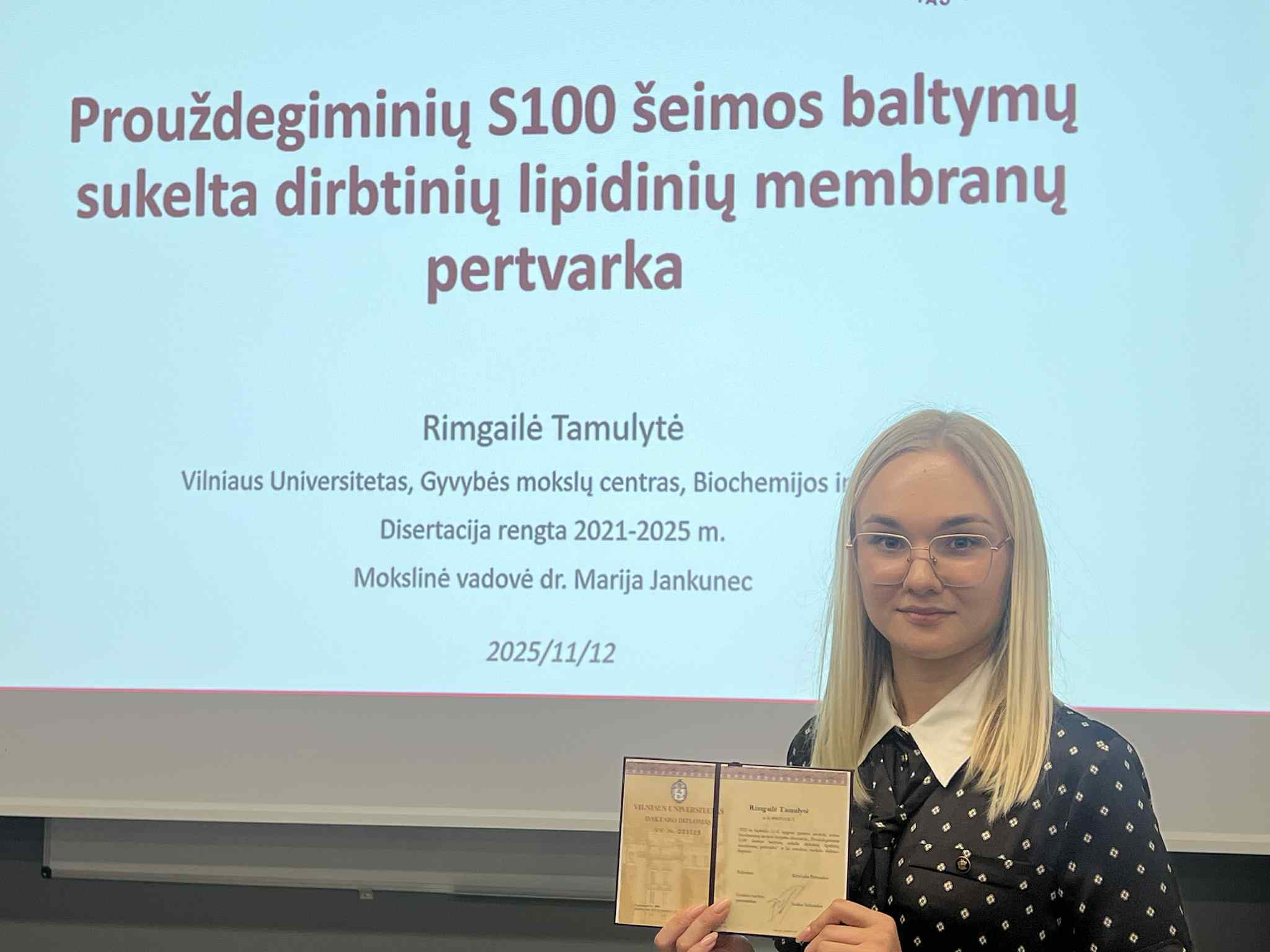
Rimgailė Tamulytė defended her thesis entitled "Remodeling of Artificial Lipid Membranes Induced by Proinflammatory S100 Family Proteins" for the degree of Doctor of Science in Biochemistry.
Scientific supervisor: Dr. Marija Jankunec (Vilnius University, Natural Sciences, Biochemistry).
Composition of the Dissertation Defense Board: Chairperson - Prof. Dr. Saulius Šatkauskas (Vytautas Magnus University, Natural Sciences, Biochemistry); Prof. Dr. Vilma Kisnierienė (Vilnius University, Natural Sciences, Biophysics), Dr. Tomas Šneideris (University of Cambridge, United Kingdom, Natural Sciences, Biochemistry), Dr. Lidija Tetianec (Vilnius University, Natural Sciences, Biochemistry N 004), Dr. Artūras Ulčinas (Center for Physical Sciences and Technology, Technical Sciences, Measurement Engineering).
Neuronal cell death resulting from plasma membrane damage is a key hallmark of neurodegeneration. Although neuroinflammation occurs in the early stages of neurodegenerative diseases, the effects of inflammation-induced proteins on membrane integrity remain unclear. The aim of this study was to investigate the interactions of the proinflammatory proteins S100A8 and S100A9, as well as their heterocomplex S100A8/A9, with an artificial lipid bilayer mimicking the neuronal plasma membrane. For the first time, this study demonstrates that direct interactions of S100A8, S100A9, and the S100A8/A9 complex with an anionic membrane compromise the integrity of the lipid bilayer. Using high-speed atomic force microscopy, real-time observations of S100A8- and S100A8/A9-induced lipid bilayer morphological changes revealed that membrane disruption occurs through a detergent-like mechanism. Meanwhile, classical atomic force microscopy showed that S100A9 insertion into the membrane leads to lateral expansion of lipid molecules and reduces the membrane’s mechanical stiffness. Finally, analysis of protein oligomerization processes revealed that changes in lipid membrane composition significantly affect S100 protein aggregation and the formation of potentially neurotoxic species. We believe that the results presented in this work will not only
enhance our understanding of the links between inflammation and neurodegeneration
but also open new opportunities for the development of diagnostic and therapeutic strategies.