

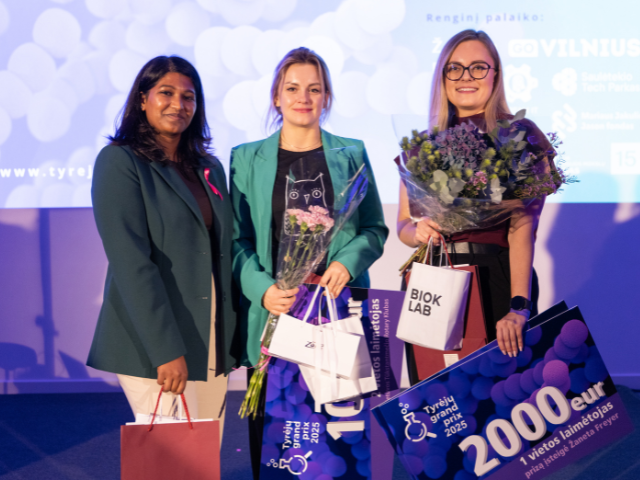
Doctoral students from Vilnius University’s Life Sciences Center (VU LSC), Solveiga Samulėnaitė and Kotryna Jakuba, were among the ten finalists selected from nearly thirty participants in the national young scientists’ competition, Researchers’ Grand Prix 2025. Both received the highest recognition – first and second place. During the event, participants had only a few minutes to present their research in a way that would be engaging and understandable to a broad audience.
The invisible world of the microbiota within us
Solveiga Samulėnaitė’s dissertation focuses on the invisible world inside us – the gut microbiota, which can have a significant impact not only on the digestive system but also on our behavior and eating habits. Her research centers on food addiction, which arises from the consumption of processed, calorie-dense foods rich in sugar and fat. Such foods alter brain activity, reinforce compulsive eating, and can lead to obesity and other eating disorders.
Her studies revealed that specific changes in the gut microbiota composition are characteristic of individuals and mice with food addiction. Moreover, by modulating the gut microbiota in mice using potential probiotics and prebiotics, it was possible to protect them from developing food addiction.
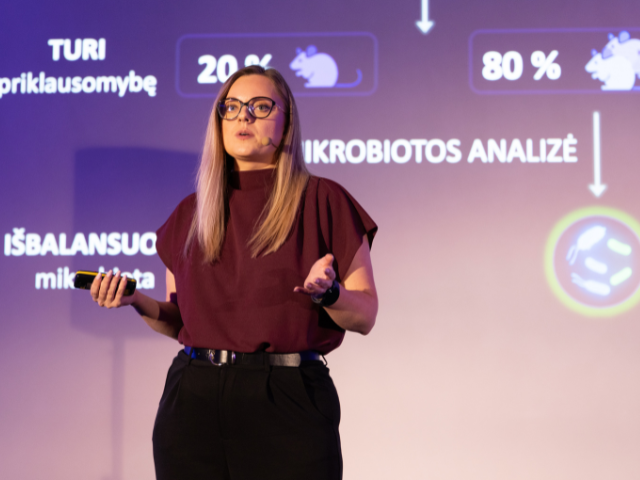 |
| Solveiga Samulėnaitė. Kristinos Petrikonytės nuotr. |
These discoveries already have practical applications – a patent application has been submitted for potential prebiotics that could, in the future, help prevent food addiction or even become part of new treatment approaches. According to Samulėnaitė, the research demonstrates that science can transcend the boundaries of the laboratory and transform into innovations with real impacts on public health.
How owls see the world
This year’s second-place winner, biophysics doctoral student Kotryna Jakuba, is trying to uncover how birds of prey perceive and interpret the world. She studies owl vision to understand how these birds track movement and respond to environmental changes. Unlike most laboratory-based experiments, Jakuba’s research is conducted in natural settings, working directly with live owls – a practice she has been pursuing for over five years. Her study relies on psychophysical methods: the birds are trained to distinguish between flashing lights, which allows researchers to measure their temporal visual resolution – how quickly and accurately they perceive moving images.
“Our goal is to understand how birds see the moving world. This helps us not only to understand animal behavior better but also to expand our knowledge of visual systems in general,” Jakuba explains. Behavior-based studies, like this one conducted with owls, have not been successfully implemented anywhere else in the world. Each result, therefore, marks a significant step forward in both animal cognition and neuroscience.
Her journey into this field began during her master’s studies. “My curiosity about owls and scientific questioning was inspired by an extraordinary person I met during my master’s in neurobiology – Dr. Mindaugas Mitkus, who is now my PhD supervisor,” she recalls. For Jakuba, the most essential part of the competition was not the prize itself but the chance to share her message.
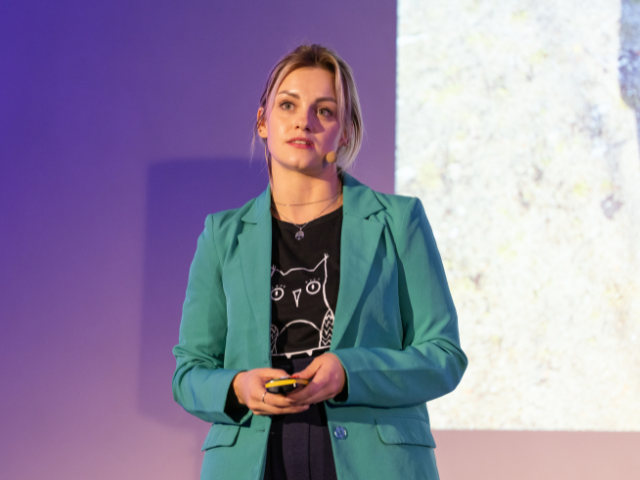 |
| Kotryna Jakuba. Kristinos Petrikonytės nuotr. |
“This competition was a personal victory for me. It’s not just second place – I succeeded in conveying why what I do matters: to me, to science, to people, and to the birds of prey I study. The feedback confirmed that my message reached its audience,” says the young scientist.
Communicating science clearly – a challenge and a necessity
Both doctoral students’ experiences in the Researchers’ Grand Prix revealed that communicating science to the public can be as challenging as conducting the research itself. With only a few minutes on stage, they had to strike a balance between scientific accuracy, clarity, and engagement. “In just a few minutes, we had to convey the essence of our research, explain the results and their significance, while also engaging the audience through questions and metaphors,” says Samulėnaitė. For her, the key was finding a balance between appeal and scientific rigor – keeping the presentation engaging while explaining complex scientific concepts in a way understandable to everyone.
Jakuba admits that the competition was also challenging because of the unknown audience. “We had very little time to deliver our message, and I had no idea who the audience would be. My field of research is very different from what is currently popular, so I wanted to make it clear that one of the most important aspects of my work with animals is the animal itself,” she says.
Both researchers agree that such events are valuable not only for showcasing their work but also as an opportunity to practice communicating science effectively. “For me, it’s essential to talk about science in a way that is understandable to everyone – not only so my field gains visibility but also to show that science can blend into everyday life and move along with it, rather than being something young people feel they must set aside,” notes Jakuba.
Samulėnaitė adds that such experiences help build trust in science. “Our work should be accessible to everyone – that builds trust in science and demonstrates its importance and real-world applicability in improving quality of life. Moreover, it encourages business involvement and helps transform research into tangible societal benefits,” she emphasizes.