

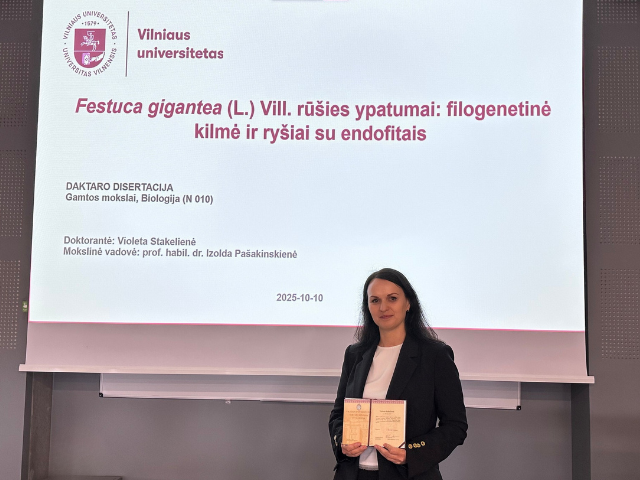
Violeta Stakelienė a defended her thesis entitled "Characteristics of Festuca Gigantea (L.) Vill.: Phylogenetic Origin and Relationships with Endophytes" for the degree of Doctor of Science in Biology.
Scientific supervisor: Prof. Habil. Dr. Izolda Pašakinskienė (Vilnius University, Natural Sciences, Biology).
Composition of the Dissertation Defense Board: Chairperson - Prof. Habil. Dr. Juozas Rimantas Lazutka (Vilnius University, Natural Sciences, Biology); Dr. Sigita Jurkonienė (Vilnius University, Natural Sciences, Biology), Prof. Dr. Vilma Kisnierienė (Vilnius University, Natural Sciences, Biophysics), Doc. Dr. Audrius Menkis (Swedish University of Agricultural Sciences, Sweden, Natural Sciences, Biology), Dr. Radvilė Rimgailė-Voicik (Vilnius University, Natural Sciences, Biology).
This study investigates the origin of the natural allopolyploid genome of Festuca gigantea and its relationships with root endophytes. For phylogenetic analyses, metaphase cytological preparations of roots from F. gigantea, its possible diploid Lolium and Festuca relatives, and L. perenne × F. gigantea hybrids were used. The FISH/GISH method enabled the identification of two-thirds of the F. gigantea genome as originating from Lolium spp. and F. pratensis chromosomes, as well as chromosomal rearrangements in L. perenne × F. gigantea hybrids, including diffuse spreading of the centromeric Fesreba RT sequence across seven L. perenne chromosomes and the presence of telomeric sequences at interstitial chromosomal sites.
To assess the diversity and distribution of root endophytic fungi and bacteria in F. gigantea, related Lolium and Festuca species, and their hybrids, endophytes were isolated from plant root tissues. In total, 21 fungal species (60 isolates) and 26 bacterial species (59 isolates) were identified. The most frequent endophytes were Microdochium bolleyi and Bacillus sp. The highest diversity of endophytic fungi was found in F. gigantea (six species), while F. arundinacea hosted the highest diversity of bacteria (nine species). The annual species L. multiflorum and L. temulentum exhibited a greater abundance of endophytic microorganisms compared to their closely related perennial species. Two Basidiomycota species — Coprinellus disseminatus and Sistotrema brinkmannii — were detected exclusively in the roots of F. gigantea.
An experiment involving inoculation of L. multiflorum seeds with suspensions of endophytic fungal spores revealed a growth-promoting effect of Cadophora fastigiata, Paraphoma fimeti, and Plectosphaerella cucumerina. The results contribute to a better understanding of allopolyploid genome formation and highlight endophytic fungi as potential biostimulators of plant growth.