

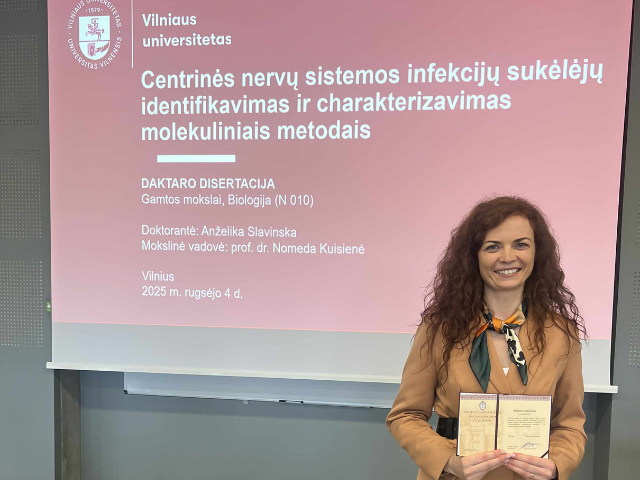
Anželika Slavinska defended her thesis entitled "Identification and Molecular Characterization of the Causative Agents of Central Nervous System Infections" for the degree of Doctor of Science in Biology.
Scientific supervisor: Prof. Dr. Nomeda Kuisienė (Vilnius University, Natural Sciences, Biology).
Composition of the Dissertation Defense Board: Chairperson - Prof. Dr. Eglė Lastauskienė (Vilnius University, Natural Sciences, Biology ); Prof. Dr. Niels Frimodt-Møller (University of Copenhagen, Denmark, Medical and Health Sciences, Medicine), Prof. Dr. Tomas Kačergius (Vilnius University, Medical and Health Sciences, Medicine), Dr. Jūratė Skerniškytė (Vilnius University, Natural Sciences, Biology), Dr. Vesta Skrodenytė-Arbačiauskienė (State Research Institute Nature Research Centre, Natural Sciences, Ecology and Environmental Science).
Research on gender differences in spatial abilities can contribute to a better understanding of how these abilities are related to sex hormones and women’s hormonal status, revealing broader mechanisms of central nervous system functioning.
In recent years, whole-genome sequencing has become a key tool for epidemiological surveillance. Molecular characterization of disease-causing microorganisms based on sequencing is of particular value, as it provides new knowledge about the biology and virulence of infectious agents and helps to detect newly emerging and antibiotic-resistant strains promptly. This study analyzed Neisseria meningitidis and Listeria monocytogenes isolates collected in Lithuania between 2009 and 2021. A detailed epidemiological review was performed, including molecular characterization of the isolates, antimicrobial susceptibility testing, and whole-genome sequencing analysis of selected isolates. The methods applied and the results obtained in this study enabled the identification of genomic differences among circulating strains and provided insights into their pathogenicity, virulence, and potential resistance to antimicrobial agents. Based on core genome and SNP analysis, this is the first study to investigate the genetic relatedness of Lithuanian isolates and strains identified in other countries. The study revealed novel strains of neuroinfection pathogens, unique variants, or combinations of virulence and antibiotic resistance genes. Detecting hypervirulent clones and circulating outbreak-associated strains highlights the need to review and strengthen epidemiological surveillance strategies in Lithuania.
 |