

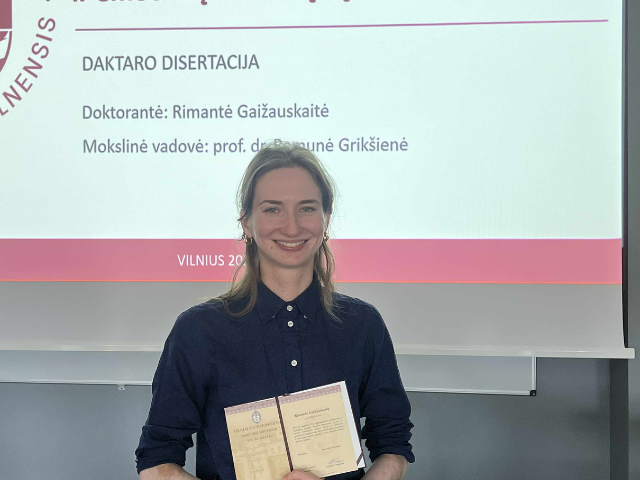
Rimantė Gaižauskaitė defended her thesis entitled "Links between sex, women's hormonal status and spatial abilities: interplay of cognitive, neurophysiological, social, and emotional factors“ for the degree of Doctor of Science in Biophysics.
Scientific supervisor: Assoc. Prof. Dr. Ramunė Grikšienė (Vilnius University, Natural Sciences, Biophysics).
Composition of the Dissertation Defense Board: Chairperson - Prof. Dr. Valentina Vengelienė (Vilnius University, Natural Sciences, Biophysics); Dr. Aurina Arnatkevičiūtė (Monash University, Australia, Natural Sciences, Biophysics); Assoc. Prof. Dr. Rokas Buišas (Vilnius University, Natural Sciences, Biophysics); Prof. Dr. Vaiva Hendrixson (Vilnius University, Medical and Health Sciences, Medicine); Prof. Dr. Dovilė Karčiauskaitė (Vilnius University, Medical and Health Sciences, Medicine ).
Research on gender differences in spatial abilities can contribute to a better understanding of how these abilities are related to sex hormones and women’s hormonal status, revealing broader mechanisms of central nervous system functioning.
The dissertation examined the relationship between sex and women’s hormonal status in spatial abilities while assessing cognitive, neurophysiological, social, and emotional factors. The study included men and women with a natural menstrual cycle (in the follicular or mid-luteal phases), women using oral hormonal contraception (OC), and those using a hormonal intrauterine device (IUD). Data were collected through psychological questionnaires, electroencephalography (EEG), and tasks assessing visual working memory and spatial abilities (mental rotation and cross-section tasks).
The results showed that neither sex nor women’s hormonal status was significantly related to measures of visual working memory or resting-state EEG. No gender differences were found in the mental rotation task; however, men outperformed women in the cross-section task (except for women using an IUD), and this difference was partly explained by emotional arousal.
In summary, the study demonstrated that the associations between sex, hormonal status, and spatial abilities are subtle and depend on social, emotional, and individual factors. The findings highlight the necessity of considering a broader spectrum of variables when comparing cognitive functions across sexes or groups with different hormonal statuses.
 |