

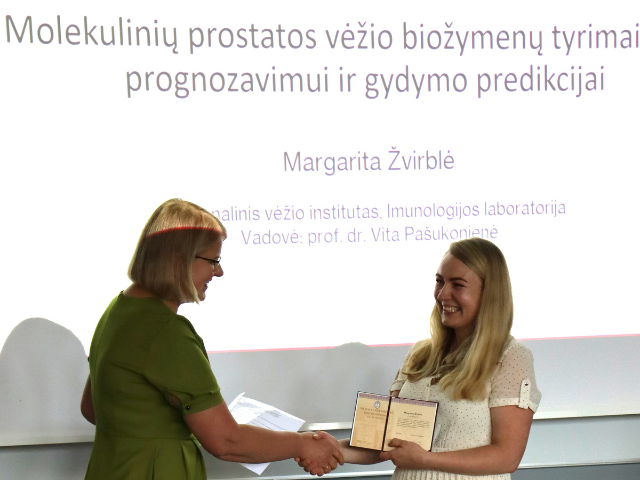
Margarita Žvirblė defended her thesis entitled "Investigation of Molecular Biomarkers in Prostate Cancer for Prognosis and Treatment Prediction" for the degree of Doctor of Science in Biology.
Scientific supervisor: Prof. Dr. Vita Pašukonienė (National Cancer Institute, Natural Sciences, Biology).
Composition of the Dissertation Defense Board: Chairperson - Prof. Dr. Daiva Baltriukienė (Vilnius University, Natural Sciences, Biology); Prof. Dr. Rostyslav Bilyy (Institute of Cellular Biology and Pathology "Nicolae Simionescu", Bucharest, Romania, Natural Sciences, Biology), Dr. Aušvydas Patašius (Vilnius University, Medical and Health Sciences, Medicine), Dr. Ilona Uzielienė (State Research Institute Centre for Innovative Medicine, Natural Sciences, Biology), Dr. Midaugas Valius (Vilnius University, Natural Sciences, Biology).
The study evaluated various molecular markers of prostate cancer (PCa) to determine their diagnostic and prognostic value, associations with disease progression, and potential to improve diagnostic accuracy and immunotherapy effectiveness.
In the DU-145 prostate cancer cell line model, to reduce diagnostic challenges caused by PD-L1 glycosylation, Bacillus subtilis IMVB 7724 lectin was used, which recognizes explicitly sialic acids – one of the key components of PD-L1 glycosylation. In addition, as an innovative drug delivery strategy, the effect of an aerosolized form of the immunotherapeutic drug atezolizumab was evaluated.
One of the main aims of the study was to identify reliable, non-invasive markers and their combinations that reflect PCa heterogeneity. Concentrations of sPD-L1 and sPD-1 were assessed in the blood of PCa patients and healthy individuals, along with their associations with clinical indicators, as well as their relationships with AR, PSMA, PCA3, and immunosuppressive cells (Tregs and MDSCs), to determine effective biomarker combinations for clinically significant PCa detection using liquid biopsy techniques readily applicable in clinical practice.
Advanced histological imaging technologies – nonlinear multimodal optical microscopy and its modalities, second- and third-harmonic generation – enabled detailed assessment of collagen remodeling, an essential component of the tumor microenvironment, in prostate tumor tissue. Textural analysis provided quantitative measures of collagen remodeling, allowing correlations with other parameters.
The study results may significantly contribute to developing personalized diagnostic and immunotherapy strategies, improving PCa prognosis, and creating a foundation for identifying novel therapeutic targets.
 |