

Vilnius University (VU) has acquired two large remote solar power plants and installed rooftop photovoltaic systems on 19 university-owned buildings in Vilnius and Šiauliai. These VU-operated solar power plants will generate up to 5,600 megawatt-hours (MWh) of electricity annually, covering about one-third of the university’s yearly electricity consumption. Along with the green electricity that VU has been purchasing from an independent supplier for the past five years, this step contributes to implementing the university’s strategic climate neutrality plan.
The electricity generated by these solar plants will not only reduce VU’s dependence on external energy suppliers but also help lower greenhouse gas emissions both in Lithuania and globally. This is an essential milestone in VU’s goal to become a leading sustainability higher education institution. Investments in renewable energy reflect the values of the VU community and its commitment to fostering an environmentally responsible mindset among students and academic staff alike.
"By preparing the projects in time, we were able to secure favorable conditions to install solar panels on the rooftops of VU buildings and acquire several remote power plants. This will allow us to meet a significant share of our electricity needs with our generation and take a step forward in implementing our sustainability policy," said VU Rector Prof. Rimvydas Petrauskas.
VU, which consumes an average of 18,000 MWh of electricity per year, has already eliminated polluting energy sources since 2021 and became one of the first large organizations in Lithuania to cover its electricity needs entirely with purchased green energy. As a result, the university already avoids emitting about 7,500 tons of CO₂ into the atmosphere annually.
In 2024, VU acquired a 2 MW solar power plant in the Kaunas district and a 2.2 MW plant in the Biržai district. Together, these two remote facilities produce about 4,400 MWh of electricity annually.
This year, solar power plants were also installed on the rooftops of 19 VU-owned dormitories and research buildings in Vilnius and Šiauliai. Most of them are located in Vilnius, on buildings in the Saulėtekis campus – including the VU Life Sciences Center. The total capacity of these rooftop systems reaches 1.37 MW, producing around 1,200 MWh of electricity annually. Altogether, the electricity generated by all VU-owned solar plants would be enough to power approximately 1,100 larger households, given that the average household in Lithuania consumes about 5.1 MWh per year.
VU plans to continue investing in solutions that reduce pollution, lower energy consumption, and protect the environment. These long-term goals are also embedded in the university’s strategy, which outlines plans to achieve climate neutrality, promote research and educational activities with significant environmental impact, and cultivate a “green” public mindset. A key focus is becoming a more sustainable, environmentally friendly institution that consistently reduces greenhouse gas emissions.
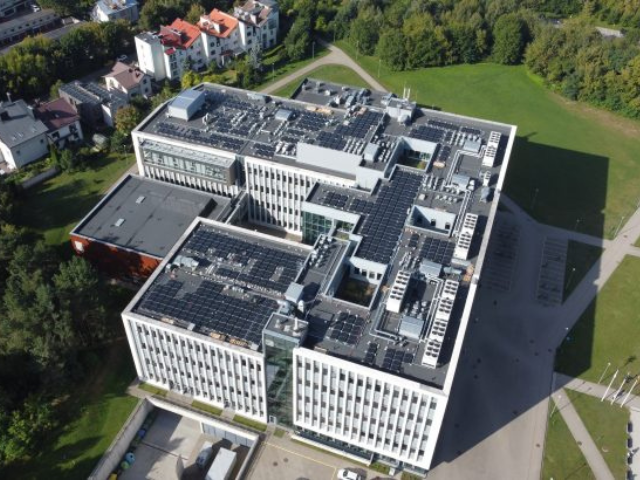 |
| VU LSC building. VU photo |