

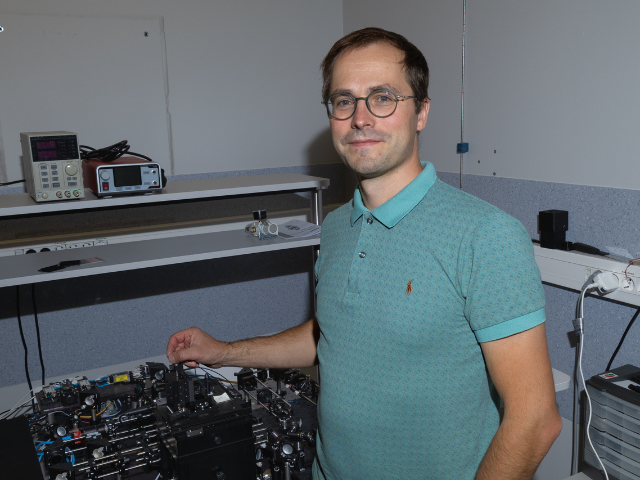
A team of researchers from Vilnius University Life Sciences Center (VU LSC) and the Center for Physical Sciences and Technology (FTMC), led by Assoc. Prof. Dr Marijonas Tutkus, has developed miEye, a super-resolution optical fluorescence microscope. According to the researchers, it is the first microscope of its kind in Lithuania to be used routinely for scientific research.
Conventional light microscopes can be used to observe cells and many of their structures, but their resolution is insufficient for studying individual molecules.
“This unique microscopy system enables us to investigate biological processes at the single-molecule level with exceptionally high sensitivity, overcoming the diffraction limit of light. This allows us to reveal details that would otherwise remain hidden due to optical blurring caused by diffraction,” explains Assoc. Prof. Dr Marijonas Tutkus.
Development of the miEye microscope began in 2020, when Assoc. Prof. Dr Tutkus received funding from the Research Council of Lithuania (LMT) for a research project with a budget of approximately €200,000. As commercial microscopy systems are expensive and purchasing one would have consumed the entire project budget, the researchers decided to build their own equipment, drawing on the open-source miCube microscopy project developed at Wageningen University in the Netherlands.
The team not only adapted the microscope's design to meet their research needs but also developed an autofocus system and microEye software for controlling the instrument and analysing research data. In 2022, these technological solutions were presented in the international scientific journal HardwareX.
One of the greatest challenges was developing a sufficiently compact and stable laser system capable of delivering the precision required for single-molecule research. The researchers chose MatchBox lasers manufactured by the Lithuanian company Integrated Optics, enabling them to integrate six different light sources into a single system.
“The opportunity to work directly with laser manufacturers and receive prompt support and advice was extremely important to us. It helped us develop this unique system within a limited budget. Moreover, our constructive collaboration with Integrated Optics enables both sides to explore new technological applications and solutions,” adds Assoc. Prof. Dr Marijonas Tutkus.
The system developed by the researchers makes it possible to conduct advanced single-molecule super-resolution studies in Lithuania using equipment designed and built by the team itself. The researchers are currently continuing to develop their microscopy technologies and are working on a second laser system.